Buy a Business: Essential Due Diligence Checklist for 2026
Buying a business is one of the most significant investments you’ll ever make. While the excitement of a new venture is compelling, the ultimate success of your acquisition hinges on a critical process that happens long before any contracts are signed: due diligence. This is your opportunity to look under the hood, meticulously verify the seller’s claims, and uncover any potential risks or hidden liabilities that could jeopardize your investment.
A superficial review is a recipe for disaster, potentially leading to devastating financial consequences and operational nightmares. Conversely, a thorough and structured investigation protects your capital, validates the purchase price, and lays a solid foundation for future growth and profitability. This guide provides an exhaustive due diligence checklist for buying a business, designed to be your comprehensive roadmap through this complex process. We will systematically break down the eight most critical areas you must scrutinize to ensure you are making a sound decision.
From deep-diving into financial records and legal compliance to assessing operational infrastructure and market position, each step is designed to provide clarity and confidence. This checklist isn’t just a list of items to tick off; it’s a strategic framework for understanding exactly what you are buying. By following this guide, you’ll be equipped with the actionable insights and detailed knowledge needed to negotiate effectively and proceed with a secure, profitable acquisition.
1. Financial Records Analysis
The cornerstone of any thorough due diligence checklist for buying a business is a deep, meticulous examination of the company’s financial records. This goes far beyond a casual glance at a profit and loss (P&L) statement. It involves a comprehensive audit of the target company’s financial statements, tax returns, balance sheets, and cash flow statements for at least the past three to five years. The goal is to verify the seller’s claims, understand the true economic engine of the business, and uncover any hidden liabilities or opportunities.
A professional analysis scrutinizes revenue trends, customer concentration, gross profit margins, and expense patterns. This process validates the business’s historical performance and provides a solid foundation for future projections, directly impacting the final valuation and deal structure.
Real-World Scenarios
Customer Concentration Risk: A buyer analyzing a digital marketing agency discovered that 40% of its reported annual revenue came from a single client. Upon further investigation, they learned the client’s contract was ending in two months with no plans to renew, leading to a significant 30% reduction in the purchase price.
Hidden Capital Expenditures: A potential buyer for a Las Vegas-based logistics company found that the seller had been consistently deferring vehicle and equipment maintenance. A detailed financial analysis revealed this tactic artificially inflated profits, and the business required an immediate $200,000 in capital expenditures post-acquisition to become fully operational, a cost negotiated into the final deal.
How to Implement This Step
Executing a proper financial analysis requires a structured approach and a keen eye for detail. Do not rely solely on the summary documents provided by the seller; dig deeper.
Engage a Professional: Hire a qualified CPA or a forensic accountant who specializes in M&A transactions. Their expertise is invaluable for spotting irregularities that an untrained eye might miss.
Drill Down to Monthly Data: Request monthly financial statements, not just annual summaries. This granularity helps identify seasonality, cyclical trends, and unusual spikes or drops that need explanation.
Verify, Don’t Trust: Compare bank deposit records against the revenue reported on the P&L statements. Any significant discrepancies are a major red flag that requires immediate clarification.
Calculate Quality of Earnings (QoE): Work with your accountant to perform a QoE analysis. This involves adjusting the reported EBITDA for non-recurring, non-core, or discretionary items (like one-time legal fees or above-market owner salaries) to determine the business’s true, sustainable earning power.
2. Legal and Compliance Review
Following financial scrutiny, a comprehensive legal and compliance review is a non-negotiable step in any due diligence checklist for buying a business. This phase involves a meticulous examination of all legal documents, contracts, permits, and regulatory matters tied to the company. The core objective is to uncover and assess any existing or potential legal liabilities, ensure the business is operating within the law, and confirm that its assets and corporate structure are sound.
A thorough legal review protects you from inheriting costly problems like unresolved lawsuits, regulatory fines, or ownership disputes. It verifies that the seller has the undisputed right to sell the business and its assets, ensuring a clean transfer of ownership and the ability to continue operations without legal interruption post-acquisition.
Real-World Scenarios
Intellectual Property Ownership: A buyer looking to acquire a branded e-commerce business discovered during the legal review that the seller never formally secured the trademark for the company name. It was still legally owned by a former partner, forcing a complex renegotiation to include the partner in the deal to transfer the IP.
Undisclosed Environmental Liabilities: An investor reviewing a manufacturing business found it was operating without the necessary EPA permits. The due diligence process uncovered this compliance gap, which required a $150,000 remediation and permitting process before the sale could proceed, with the cost borne by the seller.
Pending Litigation Risk: A buyer for a service company learned through their attorney’s investigation of a looming class-action lawsuit from former employees. To mitigate the risk, the buyer had the seller establish a $500,000 escrow fund specifically to cover potential damages and legal fees from this suit.
How to Implement This Step
A proactive and systematic legal review is crucial to safeguarding your investment. This is not the place to cut corners; professional guidance is essential.
Engage an Experienced M&A Attorney: Hire a lawyer who specializes in business acquisitions within your specific industry. Their expertise will be critical for identifying industry-specific regulations and contractual risks.
Audit All Contracts and Leases: Request and review every single contract, including those with customers, suppliers, and employees, as well as property and equipment leases. Pay close attention to assignment clauses that dictate whether the contract can be transferred to a new owner.
Verify Licenses and Permits: Create a list of all required local, state, and federal licenses and permits needed to operate the business legally. Verify that each one is current, in good standing, and, most importantly, transferable to you.
Conduct Lien and Litigation Searches: Your attorney should conduct comprehensive public record searches (including UCC lien searches) to ensure there are no outstanding liens or judgments against the business or its assets that could encumber your ownership.
Secure Representations and Warranties: Work with your attorney to include strong “reps and warranties” in the purchase agreement. These are legally binding statements from the seller confirming facts about the business, such as its compliance with all laws, providing you with legal recourse if these statements prove false.
3. Customer and Revenue Concentration Analysis
A critical component of any due diligence checklist for buying a business involves a rigorous analysis of the customer base. This step moves beyond high-level revenue figures to understand where the money truly comes from. It involves a detailed evaluation of customer lists, sales records, and contracts to identify the concentration of revenue, the stability of customer relationships, and the overall health of the company’s client portfolio. The primary goal is to uncover potential risks associated with being overly dependent on a small number of key customers.
A deep dive into customer concentration reveals the business’s vulnerability. If a significant portion of revenue is tied to one or two clients, the departure of even a single account could cripple the company’s cash flow overnight. This analysis provides a realistic view of revenue sustainability and directly informs valuation, as a diversified and loyal customer base is inherently more valuable and less risky than a concentrated one.
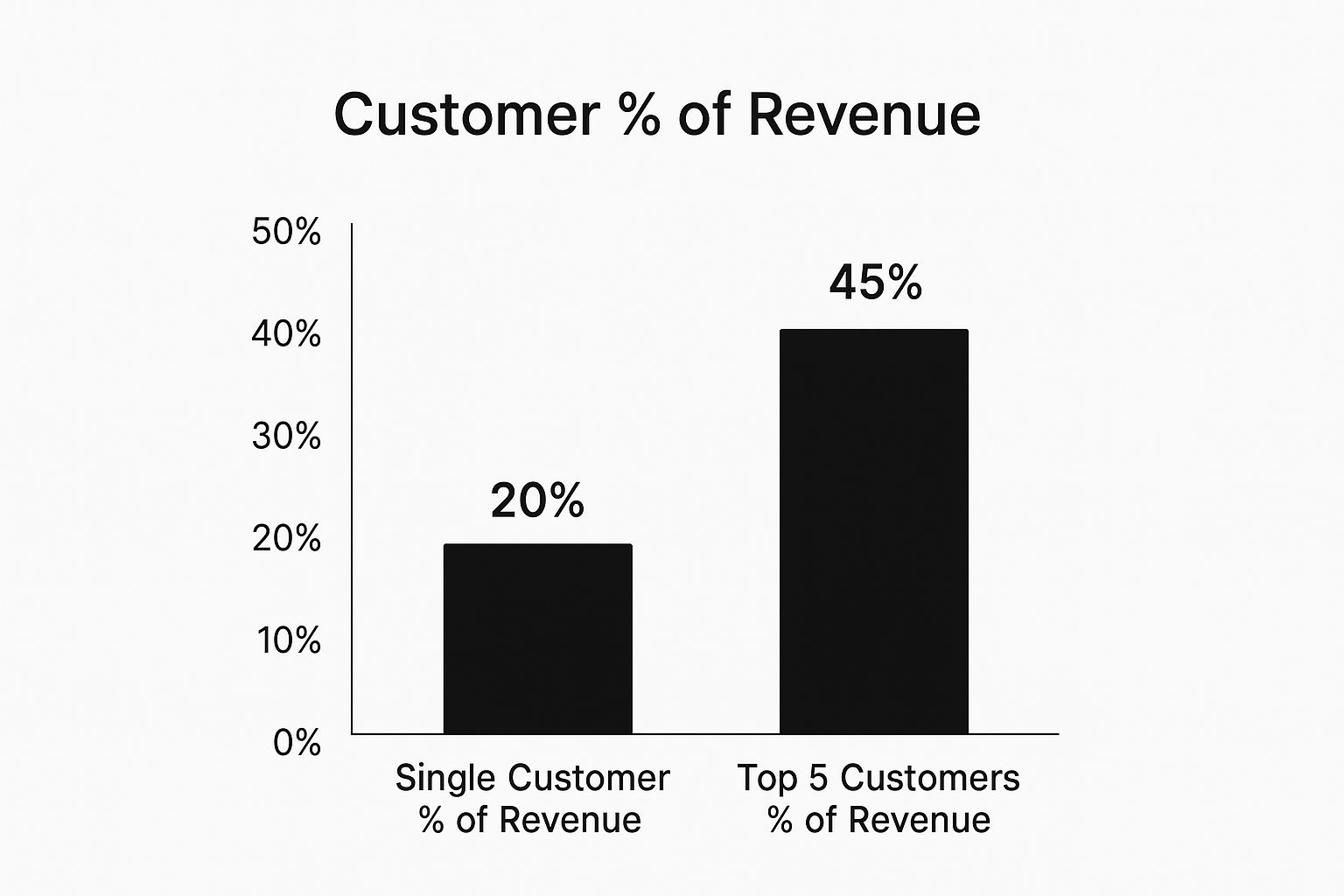
This bar chart illustrates two critical risk metrics: the percentage of total revenue generated by a single top customer versus the combined percentage from the top five customers. The visualization highlights that while no single customer dominates, a high concentration within the top five still presents a substantial risk to revenue stability.
Real-World Scenarios
Expiring Key Contract: A buyer investigating a B2B service company found that 60% of its revenue came from one major client. Further digging revealed the client’s contract was set to expire in six months with a high probability of non-renewal, leading to a 40% reduction in the final valuation.
Consolidation Risk: During due diligence for a manufacturing firm, a buyer discovered its top three customers, representing 70% of revenue, were all owned by the same private equity firm. This PE firm was actively consolidating its supplier base, posing an immense and immediate threat to the target company’s future revenue streams.
How to Implement This Step
A thorough customer analysis requires more than just a list of names; it demands a forensic look at the relationships and the numbers behind them.
Calculate Concentration Ratios: Request sales data and calculate the percentage of total revenue generated by the top 5, 10, and 20 customers. As a general rule, if any single customer accounts for more than 10-15% of revenue, it’s a red flag that warrants deeper investigation.
Analyze Customer Contracts: Scrutinize contracts for key customers. Pay close attention to renewal dates, termination clauses, pricing terms, and any change-of-control provisions that could be triggered by the sale of the business.
Assess Relationship Transferability: Determine if key customer relationships are tied to the current owner personally. If so, there is a significant risk these customers may leave after the transaction. A robust transition plan or an extended consulting agreement with the seller may be necessary.
Evaluate Customer Churn: Analyze customer retention and churn rates over the last three years. A business that is constantly losing and replacing its customer base (e.g., a 45% annual churn rate) has a much weaker foundation than one with long-standing, repeat clients.
4. Operations and Infrastructure Assessment
Beyond the numbers, a critical component of any due diligence checklist for buying a business involves a hands-on assessment of how the company actually runs. This is an evaluation of the day-to-day operational mechanics, including the processes, systems, physical assets, technology, and supply chain that enable the business to deliver its products or services. The primary goal is to understand operational efficiency, identify key dependencies, and uncover risks that aren’t visible on a balance sheet.
This analysis reveals the true health of the business’s core functions. It determines if the current infrastructure can support future growth or if it will require significant post-acquisition investment. Understanding these operational realities is crucial for ensuring a smooth transition and accurately projecting future costs and capabilities.
Real-World Scenarios
Critical Equipment Failure Risk: A buyer for a manufacturing business discovered that its most critical piece of production machinery was over 20 years old and nearing the end of its functional life. An expert inspection projected a mandatory $500,000 replacement within the next two years, a major capital expense that was negotiated as a seller concession in the final deal.
Owner Dependency: During an operations review of a local distribution company, it became clear the owner personally managed all key supplier and vendor relationships with no documented processes. This created a massive transition risk, leading to a new deal structure that included a 12-month consulting agreement to transfer those critical relationships.
Technology & Security Gaps: A firm acquiring a small tech company found its core internal systems were running on outdated, unsupported software with significant security vulnerabilities. The immediate $100,000 upgrade required to secure the systems and ensure operational continuity was factored into the valuation.
How to Implement This Step
A thorough operational assessment requires you to get inside the business and see it in action. You must move beyond high-level summaries and engage with the people and processes directly.
Be Present On-Site: Spend several days observing operations in person at different times of the day and week. This provides an unfiltered view of workflow, employee morale, and potential bottlenecks.
Request and Review SOPs: Ask for all documented Standard Operating Procedures (SOPs). The presence (or absence) of clear, updated documentation reveals the maturity and systematization of the business.
Conduct Interviews: Speak with key operations managers and frontline employees separately from the owner. This often uncovers practical challenges and insights that ownership may overlook.
Map Critical Processes: Work with the team to map out essential business processes from start to finish. This helps identify single points of failure, such as reliance on a single person or a specific piece of equipment.
Inspect Physical Assets: Hire qualified professionals to inspect all significant equipment, machinery, and facilities. Review maintenance logs to understand the history of repairs and upkeep.
5. Human Resources and Employee Evaluation
A business is often only as strong as its people, making a comprehensive human resources and employee evaluation a critical component of any due diligence checklist for buying a business. This step involves a deep dive into the company’s organizational structure, key personnel, compensation, benefits, and overall workplace culture. The objective is to assess the human capital you are acquiring, identify potential liabilities, and ensure a smooth operational transition post-purchase.
A thorough HR review validates the stability and expertise of the workforce. It uncovers risks like key employee dependencies, potential compliance issues, and low morale that could disrupt business continuity and profitability. Understanding the people side of the equation is essential for a successful acquisition.
Real-World Scenarios
Impending Talent Drain: A buyer for a software company discovered during employee interviews that the lead developer and head of sales were both planning to leave within six months of an acquisition. This prompted the buyer to negotiate significant retention bonuses and a formal transition plan into the deal terms to safeguard intellectual property and client relationships.
Contractor Misclassification: An HR audit for a growing event planning business revealed that several key team members were misclassified as independent contractors instead of employees. This exposed the business to a potential $200,000 liability in back taxes and penalties, a risk that was factored into the final purchase price negotiation.
Toxic Culture Discovery: While reviewing employee turnover data for a call center, a potential buyer noted an alarming 60% annual churn rate in a critical department. Subsequent confidential interviews revealed deep-seated morale issues and poor management, indicating significant operational problems that would require a complete overhaul post-acquisition.
How to Implement This Step
A proactive and detailed approach to HR evaluation can prevent significant post-closing headaches. Focus on gathering comprehensive data and understanding the team dynamics.
Request a Complete Employee Roster: Obtain a list of all employees with their roles, hire dates, current compensation, and bonus structures. This provides a foundational overview of the entire team.
Identify and Engage Key Employees: Pinpoint the employees who are indispensable to daily operations, customer relationships, or specialized knowledge. Plan a retention strategy, which may include bonuses or new employment agreements, well before the closing date.
Review All Employment-Related Documents: Scrutinize employment agreements, paying close attention to “change-of-control” clauses that could trigger payouts. Review HR policies, employee handbooks, and any collective bargaining agreements to understand existing obligations.
Verify Compliance and History: Work with an HR specialist or legal counsel to check compliance with all major employment laws (FLSA, FMLA, ADA). Also, review the history of workers’ compensation claims and any past employee lawsuits or disputes to assess potential liabilities.
6. Sales and Marketing Analysis
A business’s value is fundamentally tied to its ability to consistently generate revenue. A sales and marketing analysis moves beyond financial statements to dissect the how and why behind the numbers. This critical step in any due diligence checklist for buying a business involves a comprehensive examination of the company’s entire revenue generation engine, from lead acquisition and sales processes to market positioning and brand strength. The objective is to evaluate the effectiveness, sustainability, and scalability of the business’s customer acquisition strategies.
This analysis uncovers dependencies on the owner’s personal network, assesses the strength of the sales pipeline, and identifies potential for growth. It validates the seller’s revenue projections and provides a clear roadmap for maintaining and expanding sales post-acquisition, ensuring the business you buy isn’t just a reflection of its current owner’s charisma.
Real-World Scenarios
Owner-Dependent Sales: A buyer for a B2B consulting firm discovered that over 80% of new clients were sourced directly from the owner’s personal network. With no repeatable marketing system in place, this presented a significant transition risk, leading the buyer to negotiate an extended transition period with the owner to transfer key relationships.
Untapped Digital Potential: While reviewing a local service company, a potential buyer found they were spending $50,000 annually on outdated print ads with poor ROI. A digital audit revealed that competitors dominated online search, presenting a clear opportunity to reallocate the marketing budget to high-return channels like SEO and paid search to drive significant growth.
How to Implement This Step
A thorough sales and marketing review requires looking at both quantitative data and qualitative factors to build a complete picture of the business’s market presence.
Analyze Lead Sources and Funnels: Request a detailed breakdown of all lead sources for the past 2-3 years. Analyze the conversion rates from lead to customer for each channel to understand which ones are most effective and profitable.
Evaluate Digital Assets: Conduct a full audit of the company’s digital footprint. This includes website traffic analytics, search engine rankings for key terms, social media engagement, and the quality of their email marketing lists.
Assess the Sales Process: Review the entire sales pipeline, including average deal size, sales cycle length, and close rates. If there is a sales team, evaluate their structure, compensation, and performance metrics.
Conduct Competitive Analysis: Identify the top 3-5 competitors and analyze their market positioning, pricing strategies, and marketing tactics. This helps determine the target company’s competitive advantages and potential vulnerabilities. Learn more about what makes a business attractive to buyers and how a strong market position plays a key role.
7. Asset Verification and Valuation
A critical component of any due diligence checklist for buying a business involves verifying and valuing the company’s assets. This process confirms that what you’re told you’re buying actually exists, is owned by the business, is in the condition represented, and is properly valued. It covers a wide range of items, from physical assets like machinery and inventory to intangible assets such as intellectual property, customer lists, and goodwill.
This step is essential for justifying the purchase price. Discovering that assets are overvalued, in poor condition, or encumbered by liens can dramatically alter the economics of a deal and protect you from post-acquisition surprises and immediate capital outlays.
Real-World Scenarios
Inventory Discrepancy: A buyer for a retail business conducted a physical inventory count before closing. They discovered the actual value of sellable stock was $150,000 less than what was reported on the financial statements due to obsolete and damaged goods, resulting in a direct reduction to the purchase price.
Undisclosed Lien: During a Uniform Commercial Code (UCC) search for a construction company, the buyer’s attorney found a $200,000 lien against a key piece of heavy equipment. The seller had failed to disclose this, and the discovery forced the seller to pay off the debt before the asset could be transferred free and clear.
Overstated Book Value: An appraisal of a manufacturing facility’s specialized equipment valued it at a fair market value of $300,000, significantly less than its $600,000 book value. This impacted not only the purchase price allocation but also future depreciation tax shields for the buyer.
How to Implement This Step
A meticulous approach to asset verification prevents you from overpaying for a business. It requires a hands-on, detail-oriented effort.
Conduct Physical Inspections: Do not rely solely on the seller’s asset list. Physically walk the premises, count major assets, and inspect the condition of all significant equipment, vehicles, and facilities.
Perform Lien and Title Searches: Engage your legal counsel to conduct UCC searches for liens on all personal property and title searches for any real estate. This ensures the seller has the legal right to transfer the assets.
Hire Professional Appraisers: For significant assets like real estate, specialized machinery, or valuable intellectual property, hire a qualified, independent appraiser to determine their fair market value. Understanding this is a core part of the process, and you can learn more about why every business owner should consider a valuation.
Scrutinize Intangibles: Verify that all intellectual property (trademarks, patents, copyrights) is properly registered and legally owned by the company, not an individual. Review customer lists for accuracy and concentration.
8. Industry and Competitive Position Analysis
A business does not exist in a vacuum; its success is deeply intertwined with the health of its industry and its standing among competitors. An essential part of any due diligence checklist for buying a business involves looking beyond the company’s internal operations to analyze the external market. This strategic evaluation assesses industry trends, competitive dynamics, regulatory landscapes, and the target company’s unique position within this ecosystem. The goal is to determine if you are buying a business in a growing, stable, or declining market.
This analysis provides critical context for the financial records. Strong past performance means little if the entire industry is about to be disrupted by new technology or regulations. Understanding the company’s competitive advantages, or lack thereof, is fundamental to forecasting its long-term viability and growth potential.
Real-World Scenarios
Declining Market Risk: A buyer was interested in a highly profitable printing company. However, their industry analysis revealed the local market for print services was declining by 5% annually due to digital alternatives. This projected decline in future revenue enabled the buyer to justify a lower valuation, acknowledging the limited long-term growth prospects.
Unseen Regulatory Threats: During due diligence for a successful Las Vegas-based private security firm, a buyer’s research uncovered pending state legislation that would mandate expensive new training and licensing requirements. This discovery led to a negotiation where the seller placed $500,000 in escrow to cover the anticipated compliance costs.
Untapped Consolidation Opportunity: An investor analyzing a plumbing business discovered it held a 30% share in a highly fragmented local market with no other major players. This identified a clear strategic opportunity to acquire smaller competitors and consolidate the market, a key factor that made the acquisition more attractive.
How to Implement This Step
A thorough market analysis requires a combination of research, strategic thinking, and expert consultation. Go beyond the seller’s narrative about their market position and validate it with independent data.
Consult Industry Reports: Purchase or access reports from firms like IBISWorld, Gartner, or Statista. These provide professional, unbiased data on industry size, growth rates, key trends, and major players.
Apply a Strategic Framework: Use a structured model like Porter’s Five Forces to analyze competitive intensity, the threat of new entrants, the bargaining power of buyers and suppliers, and the threat of substitute products. This provides a holistic view of the competitive landscape.
Benchmark Against Competitors: Identify the top 5-10 direct and indirect competitors. Analyze their websites, marketing, pricing, and online reviews to understand the target company’s relative strengths and weaknesses.
Assess Future Disruptions: Research emerging technologies, changing consumer behaviors, and pending regulations that could either threaten the business model or create new opportunities. Understanding these dynamics is crucial for any forward-looking business plan. To get a sense of which sectors are poised for growth, you can learn more about the hottest industries in Las Vegas for 2025.
Due Diligence Checklist: 8 Key Areas Compared
Aspect
Financial Records Analysis
Legal and Compliance Review
Customer and Revenue Concentration Analysis
Operations and Infrastructure Assessment
Human Resources and Employee Evaluation
Sales and Marketing Analysis
Asset Verification and Valuation
Industry and Competitive Position Analysis
Implementation Complexity 🔄
Moderate – requires accounting expertise
High – specialized legal knowledge needed
Moderate – data analysis and customer contact
High – on-site assessment and expert inspection
Moderate – data review and employee interviews
Moderate – multi-channel data analysis
High – physical inspections and appraisals required
Moderate to High – requires industry knowledge
Resource Requirements ⚡
CPA/accountant, financial records, time
Experienced attorney, legal documents, budget
Sales data, customer contracts, possible interviews
Operations team, equipment inspectors, IT review
HR experts, employee data, management access
Marketing and sales data, digital assets review
Appraisers, physical asset access, legal checks
Industry reports, market research, expert input
Expected Outcomes 📊
Validates financial health and profitability
Identifies legal risks and ensures compliance
Reveals revenue risk from customer dependence
Highlights operational risks and capital needs
Assesses employee risks, retention, and compliance
Validates revenue drivers and marketing effectiveness
Confirms asset existence and value, detects liens
Understands market position, industry trends, threats
Assesses competitive position and sustainable sales
Ensures all assets are verified and properly valued
Provides strategic context for long-term viability
Turning Your Due diligence into a Done Deal
Navigating the extensive journey of buying a business is less about crossing a finish line and more about building a solid foundation for your future success. The comprehensive due diligence checklist for buying a business we’ve outlined is your architectural blueprint. It transforms the abstract idea of a “good business” into a tangible, verifiable, and quantifiable asset. By meticulously working through each stage, you move beyond the seller’s narrative and into the realm of hard data and operational reality.
You’ve learned to dissect financial statements, not just read them. You can now identify the red flags in legal documents, gauge the risk of customer concentration, and assess the true strength of a company’s operational infrastructure. This process isn’t just about avoiding a bad investment; it’s about uncovering the hidden potential and understanding the precise challenges you will inherit on day one.
From Checklist to Action: The Power of Your Findings
The true power of due diligence lies in how you use the information you uncover. Your findings are not merely a pass-fail grade on the business. They are your most valuable negotiation assets, providing the leverage needed to shape the final deal in your favor.
Validating the Valuation: Does the financial deep-dive support the seller’s asking price? Your analysis of cash flow, profit margins, and growth trends provides the objective evidence needed to confirm or contest the valuation.
Negotiating Purchase Price and Terms: Uncovering an unrecorded liability, an overvalued asset, or an impending customer departure gives you a powerful reason to renegotiate the price. You might also negotiate terms, such as a larger seller financing note or a longer training period, to mitigate identified risks.
Securing Seller Concessions: If you discover deferred maintenance on critical equipment or a looming compliance issue, you can request that the seller rectifies these problems before closing or provides a credit to cover the future expense.
Making the “Walk Away” Decision: Perhaps the most crucial outcome of due diligence is gaining the clarity and confidence to walk away from a deal that doesn’t align with your financial or strategic goals. A thorough checklist protects you from making an emotional decision that could lead to financial ruin.
Ultimately, this rigorous process de-risks what is likely one of the most significant financial commitments of your life. It ensures you are not just buying a business; you are making a strategic investment with your eyes wide open, fully aware of its strengths, weaknesses, and genuine growth potential. The confidence gained from this methodical investigation is priceless, setting the stage for a smooth transition and a prosperous future as a business owner.
Ready to turn your acquisition goals into reality? Navigating a comprehensive due diligence checklist for buying a business requires expert guidance. The seasoned professionals at Vic & Wayne Brokers specialize in guiding Las Vegas entrepreneurs through every complex step, ensuring a secure and successful transaction from initial analysis to final closing. Contact Vic & Wayne Brokers today to leverage our local market expertise for your next acquisition.